KEY TAKEAWAYS
- About $875 billion of commercial and multifamily mortgages, 17% of all outstanding balances, mature in 2026, which means more owners facing a decision.
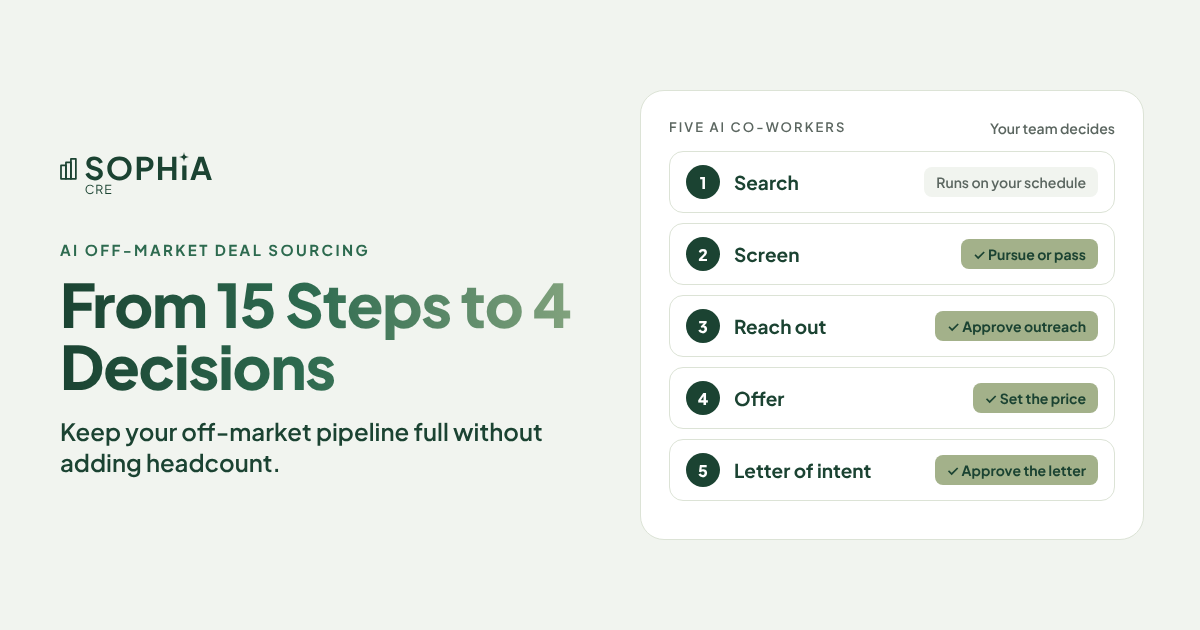
- A manual off-market search takes about 15 steps, and only four of them need someone’s judgment.
- With Sophia, the same job runs as five connected AI Co-Workers and four team decisions: pursue, approve outreach, set the price, and approve the letter of intent.
- Nothing goes to an owner until someone on your team approves it in Microsoft Teams or Slack. Sophia members typically see their first workflows live 30 to 45 days after kickoff.
IN THIS ARTICLE
Keep your off-market pipeline full without adding to your acquisitions team.
The best deals never hit a listing site, and the buyer who reaches the owner first, with a credible offer, usually gets the conversation. Most acquisitions teams know this. Few have the hours to work an off-market pipeline every week. Here is how AI changes that, and where your team stays in charge.
Ask any acquisitions team how their off-market program is going and you’ll usually hear the same story. It started strong. Someone built a target list, sent a round of letters, and logged the replies in a spreadsheet. Then two live deals hit underwriting at the same time, and the spreadsheet hasn’t been touched since.
That isn’t a discipline problem. It’s a capacity problem. Off-market sourcing is long, repetitive work with no deadline, so it’s always the first thing to slip when the team gets busy. And the pipeline it feeds dries up three months later, when it’s too late to catch up.
Why the timing matters right now
Owners are more likely to sell when something forces a decision, and debt is the most common trigger. According to the Mortgage Bankers Association, about $875 billion of commercial and multifamily mortgages, 17% of all outstanding balances, mature in 2026. That includes 13% of multifamily mortgages.
Every one of those maturities is a possible conversation with an owner who has to refinance, recapitalize, or sell. The firms that find those owners first, with a clear and credible approach, get the first look. The firms that rely on brokers see the deal after everyone else.
The manual version: about 15 steps
Done by hand, even with a chat tool helping, a typical off-market search looks like this:
- Search listing and data sites for properties in your markets
- Copy the results into a spreadsheet
- Pull county assessor and tax records
- Pull loan records
- Paste it all into a chat tool to estimate the numbers
- Check the math
- Fix what the chat tool got wrong
- Dig through entity filings to find the real owner behind the LLC
- Paste your notes into a chat tool to draft a letter
- Personalize each letter
- Send it and track replies
- Build the offer when an owner responds
- Paste the terms into a chat tool
- Reformat the draft into your letter of intent template
- Email it around for approval
Every step starts and stops with a person copying, pasting, and checking. Only four of those steps actually need someone’s judgment.
The workflow version: five AI Co-Workers, four decisions
With Sophia, the same job runs as five connected workflows. At Sophia, we call them AI Co-Workers, because each one does a specific job and then hands its finished work to the next. Your team steps in only at the four points where a decision is needed.
Workflow 1: Search
On the schedule your team chooses, Sophia searches your target markets against your buy box: location, unit count, assessed value, ownership history, and loan details. It cross-references property, county assessor, tax, and loan records, and saves every result. Nobody has to remember to run it.
Workflow 2: Screen
Every match arrives as a shortlist card. Each card shows which figures are sourced, which are estimated, and which are unknown, so your team knows exactly what to trust. When operating statements aren’t available, Sophia estimates income, expenses, and net operating income from public market data.
Seller-motivation signals, such as long hold periods, older loans, and likely loan maturities, are called out, so the right owners get attention first.
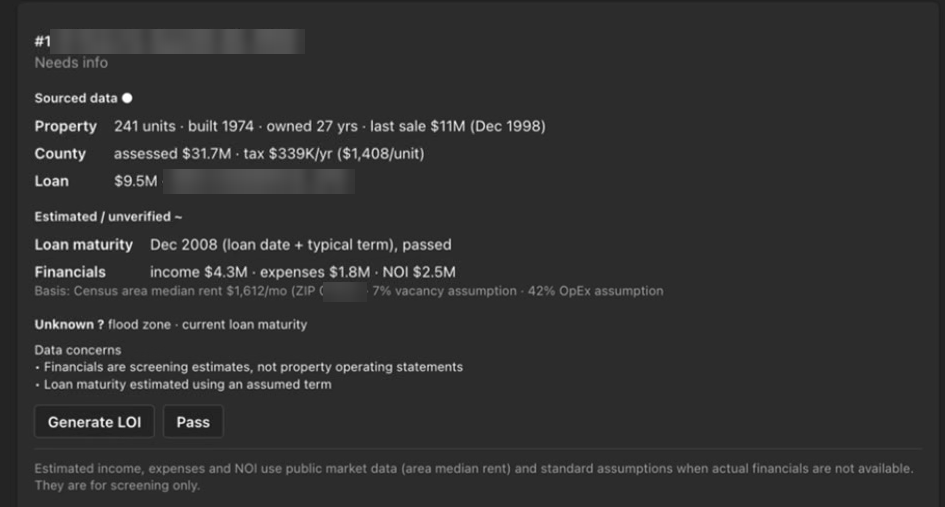
Decision 1: Your team decides to pursue or pass.
Workflow 3: Reach out
For every property your team pursues, Sophia identifies the ownership entity behind it and drafts personalized outreach to the owner, built around what it learned in screening.
Decision 2: Your team approves, edits, or declines the outreach in Microsoft Teams or Slack. Nothing goes to an owner until someone says yes. Once approved, Sophia sends it and tracks who has responded.
Workflow 4: Offer
When an owner is interested, one click opens an offer form that’s already filled in with the property, the estimated net operating income, and the parties. Unverified figures are flagged before anyone submits.
Decision 3: Your team enters a cap rate or a price, and Sophia calculates the rest.
Workflow 5: Letter of intent
Sophia drafts the letter of intent in your firm’s own Word template, with your format and standard terms, and fills in earnest money and dates. Open items, such as a missing broker or an assumed term, are flagged before approval.
Decision 4: Your team approves, declines, or requests a revision, and every decision is recorded.
Why owner research needs more than one AI model
Owner research is exactly the kind of work where a single AI model can sound sure and be wrong. Entity names look alike. Records go stale. The owner of record may have sold two years ago.
If one model does that research alone, one mistake can put a polished letter in front of the wrong person, under your firm’s name. Owners talk, and brokers talk more.
Sophia’s proprietary AI Synchronization Model™ sends each step to the AI model that’s best at it and has the other models cross-check the result before it moves on. Then a person on your team approves it. That combination is what makes fast outreach safe to send.
What the owner sees
An owner doesn’t know or care how your letter was produced. They care whether it’s accurate, specific, and respectful of their time. A generic blast reads like spam, and owners can tell.
Because the workflow screens each property and researches the owner first, the draft can speak to that owner’s actual situation. Because your team approves every message, it sounds like your firm. And because the process runs on a schedule, every owner gets the same careful approach, whether the search ran on a busy Tuesday or a quiet Friday night.
What changes for your acquisitions team
At most middle-market firms, a few people cover the whole deal cycle, from sourcing through underwriting to closing. AI off-market deal sourcing doesn’t add a person to that team. It gives the same team a full pipeline, a shortlist instead of a spreadsheet, and more hours for the work that actually wins deals: owner conversations, pricing judgment, and negotiation.
It also leaves a record. Mission Control, part of the Sophia platform, shows every search, approval, and result, with a full audit trail and a real-time scorecard of hours and dollars saved against your starting baseline. You’ll know how many properties were screened, how many owners were contacted, how many replied, and how long approvals took. If replies are weak, you fix the message. If approvals sit for days, you fix the approval path.
This is how Sophia members work: Learn → Automate → Scale. Your team learns AI. Sophia automates your slowest work. You scale without adding headcount.
How to get ready
You don’t need anything new to start. A few decisions make the first workflows sharper:
- Write down your buy box in plain language: what’s in, what’s out, and why.
- Pick your first markets or property types.
- Decide who approves outreach and offers, and whether your team works in Microsoft Teams or Slack.
- Gather your letter of intent template and standard terms.
- Measure today’s process: how many hours a week sourcing takes now, so you have a baseline.
Off-market sourcing is one of hundreds of layered workflows Sophia runs across acquisitions, asset management, accounting, leasing, and investor relations. For a side-by-side look at the same deal search with chat tools and with Sophia, see Using AI on Your Own vs. Sophia, or read why AI chat tools and AI workflows aren’t the same thing.
Frequently asked questions
What is AI off-market deal sourcing?
It’s a chain of connected workflows that finds properties matching your buy box, screens them, identifies the owners, drafts outreach, and prepares the offer and letter of intent. Your team makes every decision along the way.
Will Sophia contact owners on its own?
No. Nothing goes to an owner until someone on your team approves it in Microsoft Teams or Slack. Once approved, Sophia sends the outreach and tracks replies.
What happens when operating statements aren’t available?
Sophia estimates income, expenses, and net operating income from public market data, and labels each figure as sourced, estimated, or unknown so your team knows what to trust.
Can it use our letter of intent template?
Yes. The letter of intent is drafted in your firm’s own Word template, with your format and standard terms, and open items are flagged before approval.
Does this replace my acquisitions team?
No. It takes the searching, copying, and checking off their desks, so they can spend their time on owners, pricing, and negotiation. As people naturally move on, many firms find they can take on more deals without adding staff.
How fast can it be running?
Sophia members typically see their first production workflows live 30 to 45 days after kickoff.
Sources
- Mortgage Bankers Association, “17 Percent of Commercial and Multifamily Mortgage Balances to Mature in 2026,” February 9, 2026 ($875 billion maturing in 2026; 13% of multifamily mortgages). Link
Turn a 15-step search into four decisions.
See how Sophia members keep an off-market pipeline full while their team stays in charge of every message and every offer.
Learn → Automate → Scale. Your team learns AI. Sophia automates the rest.