KEY TAKEAWAYS
- When mystery-shopped, leasing teams took an average of 11.8 hours to respond to renters, and one third never responded at all.
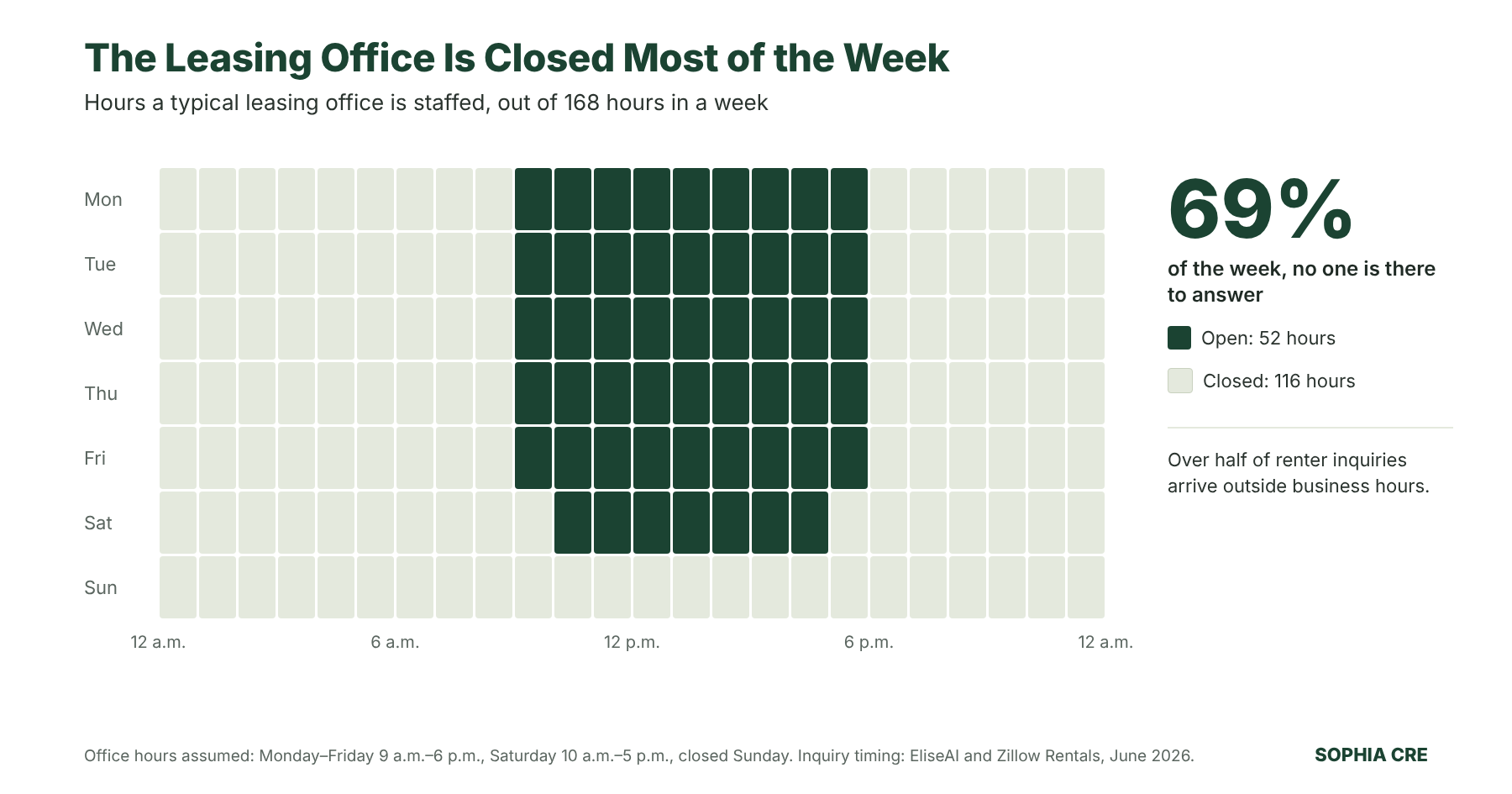
- A typical leasing office is closed 69% of the week, even though more than half of rental inquiries arrive outside business hours.
- Speed is a major differentiator: renters engaged with an AI leasing assistant were 43% more likely to apply and 24% more likely to sign a lease.
- Every vacant day costs lost rent. Cutting just five days from each turn on a 300-unit property can add roughly $40,000 a year in NOI.
IN THIS ARTICLE
Stop losing renters while your leasing office is closed.
A renter who calls or writes to your property at 9 p.m. is ready to act tonight. Most leasing teams answer sometime tomorrow, and many never answer at all. Here is what that gap costs, and how operators are closing it.
Every multifamily CEO knows the vacancy number for their portfolio. Very few know the number that drives it: how long it takes their team to answer a renter who asks about an apartment.
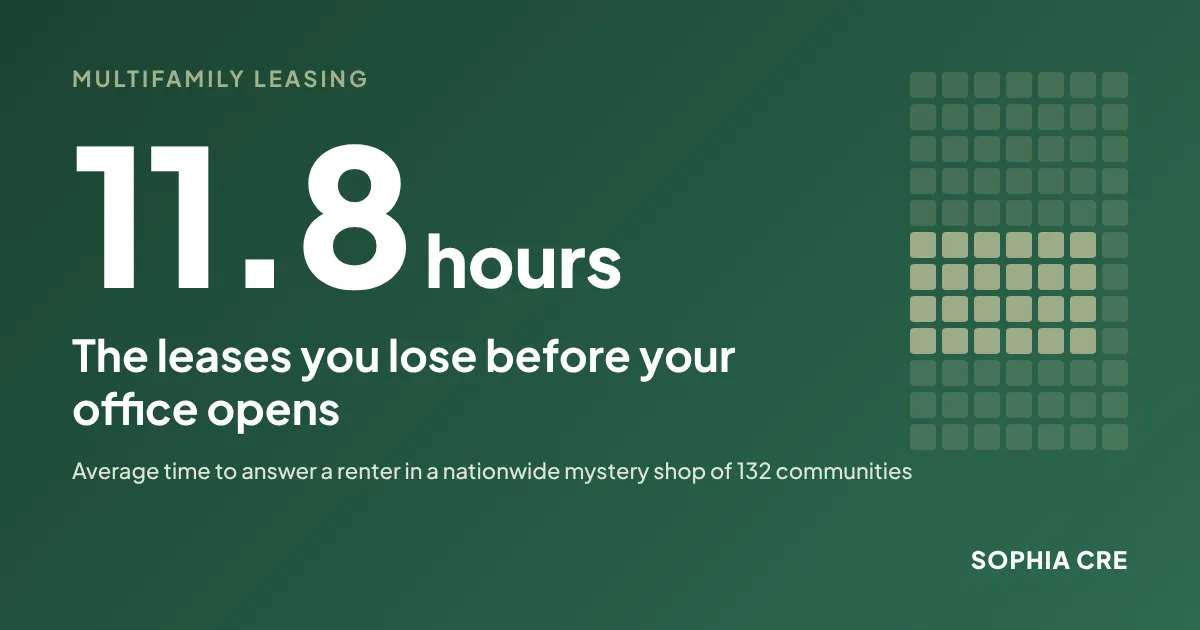
When EliseAI mystery-shopped 132 communities run by 44 property management companies, the average response time was 11.8 hours. One third of the properties never responded at all.
That is the 11.8-hour problem. A prospect asks a simple question about availability, pets, or a deposit. The answer arrives the next day, if it arrives. By then the renter has toured somewhere else.
The renter is shopping right now
Renters don’t wait for business hours. According to EliseAI and Zillow Rentals, more than half of rental inquiries arrive outside them.
Now look at when the leasing office is actually open. A common schedule, Monday through Friday from 9 a.m. to 6 p.m. plus Saturday from 10 a.m. to 5 p.m., covers 52 hours. The week has 168. For 116 of them, about 69% of the week, no one is there to answer.
Business hours are not the only gap. EliseAI’s 2025 mystery shop of more than 10,000 calls to US leasing offices found that onsite teams answered about 70% of calls, and the company estimates 28% of leads are wasted along the way. A busy leasing agent touring one prospect is not picking up the phone for the next one.
Speed decides who gets the lease
The cost of waiting is not unique to apartments. In a widely cited Harvard Business Review study of more than 2,200 US companies, firms that responded to an online inquiry within an hour were nearly seven times as likely to qualify the lead as firms that waited even one more hour, and more than 60 times as likely as firms that waited a day or longer.
Renters behave the same way. They send the same inquiry to several properties. The first one to answer clearly, and offer a tour, usually gets the tour. The property that answers the next afternoon is competing for a renter who has already made plans.
What a fast answer is worth
The evidence on faster, around-the-clock response is strong enough that it is now showing up in large operator data.
- More applications, tours, and leases. In a June 2026 study, Zillow Rentals and EliseAI found that renters who engaged with an AI leasing assistant on Zillow listings were 43% more likely to apply, 19% more likely to book a tour, and 24% more likely to sign a lease than renters at buildings without one.
- Higher tour conversion. In a case study published by its leasing software provider, Kane Realty reported a 46% conversion rate for prospects handled by AI, compared with 19% tour conversion for prospects who weren’t.
- Faster paperwork. In its provider’s case study, Charney Companies cut application approvals from two to three days to under 24 hours, and staff time per move-in from more than six hours to under one.
These are vendor-reported results, and every portfolio is different. But they point the same direction: when renters get a fast, complete answer, more of them sign.
Every vacant day comes out of NOI
Slow response doesn’t show up as its own line on the operating statement. It shows up as vacancy.
RealPage analytics found that the average apartment sat vacant for about 34 days between residents at the end of 2024, nearly five days longer than the average in the five years before 2020. Some of that time is make-ready work. Much of it is the leasing funnel: inquiries waiting for answers, tours waiting to be booked, and applications waiting for approval.
Here is a simple illustration. Take a 300-unit property with average rent of $1,800 a month and 45% annual turnover. That is about 135 move-outs a year, and each vacant day costs about $59 in lost rent. Cut five vacant days from each turn and the property keeps roughly $40,000 a year in NOI. At a 5.5% cap rate, that is about $725,000 of asset value, from one property, without raising rent.
Multiply that across a portfolio and response time stops being a front-office detail. It becomes one of the cheapest NOI levers a CEO has.
Why “hire another leasing agent” doesn’t fix it
The traditional answer to slow response is more people. It rarely works for long.
Another agent still works business hours. Agents still tour, process paperwork, and handle resident issues, so the phone still rings while they’re busy. Leasing roles also turn over often, which means constant hiring, onboarding, and retraining. And payroll grows faster than rent, which is exactly the margin squeeze middle-market sponsors are already feeling.
The goal is not a bigger leasing team. It is a leasing process where every inquiry gets a fast, accurate answer, at any hour, and your people spend their time where they matter most: tours, renewals, and residents.
This is not a layoff plan
Fixing response time with AI doesn’t mean replacing your leasing staff. It means your current team stops losing renters to the clock.
AI handles the first response, the routine questions, and the follow-ups that slip through the cracks overnight and on weekends. Your team picks up warm, qualified prospects in the morning. As leasing roles turn over naturally, you may find you don’t need to backfill every one, and the people who stay do more valuable work. That is reduction through attrition, on your schedule, not cuts.
How AI-powered operators close the gap
The operators getting ahead of this follow the same sequence.
Learn. The team builds real AI skills on its own work, including leasing. People who understand what AI can do spot the handoffs where renters fall through.
Automate. The slowest steps get rebuilt with AI doing the first pass: answering inquiries, following up, moving applications forward, and flagging anything unusual. A person approves, rejects, or modifies the result, right inside Microsoft Teams or Slack.
Scale. Every workflow is measured against a baseline in hours and dollars, so leadership can see the impact on vacancy and NOI, and keep extending it across the portfolio. Growth no longer requires adding headcount at the same rate.
This is how Sophia members work: Learn, Automate, Scale. Your team learns AI. Sophia automates your slowest work. You scale without adding headcount.
Find out what your clock says
Before you change anything, measure it. Send an inquiry to three of your own properties tonight, one by email, one through a listing site, and one by phone after hours. Note how long each takes to get a real answer, and whether that answer includes a tour time. Then do the same with your top two competitors.
Most CEOs who try this are surprised by what they find.
If you want to see how an AI operating model would work at your firm, book a demo with the Sophia team. We’ll walk you through the platform, show you how members are putting AI to work across leasing, asset management, and accounting, and talk through where your firm’s biggest time savings are likely to be. Sophia members typically see their first production workflows live 30 to 45 days after kickoff.
Stop Losing Leases to the Clock.
See how an AI operating model answers every renter, at any hour, and hands warm prospects to your team in the morning.
Learn → Automate → Scale. Your team learns AI. Sophia automates the rest.
Sources
- EliseAI, “The 5 Top Insights from a Nationwide Mystery-Shop,” January 27, 2023 (132 communities, 44 property management companies; 11.8-hour average response; one third never responded). Link
- EliseAI and Zillow Rentals press release, “Renters Who Use AI Assist Are 43% More Likely to Apply,” Business Wire, June 11, 2026 (43% / 19% / 24% lifts; over half of inquiries after hours). Link
- EliseAI, 2025 Mystery Shopping Report (10,000+ calls; 70% onsite answer rate; 28% of leads wasted). Link
- James B. Oldroyd, Kristina McElheran, and David Elkington, “The Short Life of Online Sales Leads,” Harvard Business Review, March 2011. Link
- Funnel, “All in on AI: How Kane uses Funnel to power better leasing and living” (46% vs. 19%). Link
- Venn, “How Charney Unlocked $231 per Lease with Leasing Automation.” Link
- RealPage Analytics, Dustin Weaver, “Average Vacant Days Climbs Above Pre-Pandemic Level,” February 2025 (about 34.4 days at end of 2024). Link